
For the last several months at Ploomba, we've been designing algorithms to help you predict your yields and forecast your fields in the most effective and efficient way possible. We've built an algorithm that we're proud to share with you.
Yield prediction has always been one of agriculture's biggest challenges. Too optimistic and you over-commit on contracts. Too conservative and you leave money on the table. Traditional methods rely on experience, gut feeling, and labor-intensive manual sampling across entire fields. We knew there had to be a better way.
Real-time detection and annotation of strawberries in field
The Problem with Traditional Methods
Most yield estimation approaches make unrealistic assumptions. They assume your field is uniform, that plants are evenly distributed, and that your data follows a perfect bell curve. But anyone who's worked in agriculture knows this isn't reality.
Fields have hot spots and cold spots. Plant density varies. Weather impacts different areas differently. Some sections have better drainage, different sun exposure, or were planted on slightly different days. Traditional statistical methods break down when faced with this real-world complexity.
"We needed an algorithm that could handle the messiness of actual farming, not the clean simplicity of a textbook."
What Makes Our Algorithm Stand Out
1. Works with Small Samples
You don't need to sample the whole field. A few representative spots give reliable estimates, saving time and effort. Our algorithm uses advanced statistical techniques to extrapolate from limited data points while accounting for spatial variation across your field.
Instead of spending days walking every row, you can take strategic samples from different zones of your field. The algorithm identifies which areas are representative and which are outliers, then weighs them appropriately in the final calculation. This means you get accurate estimates in a fraction of the time.
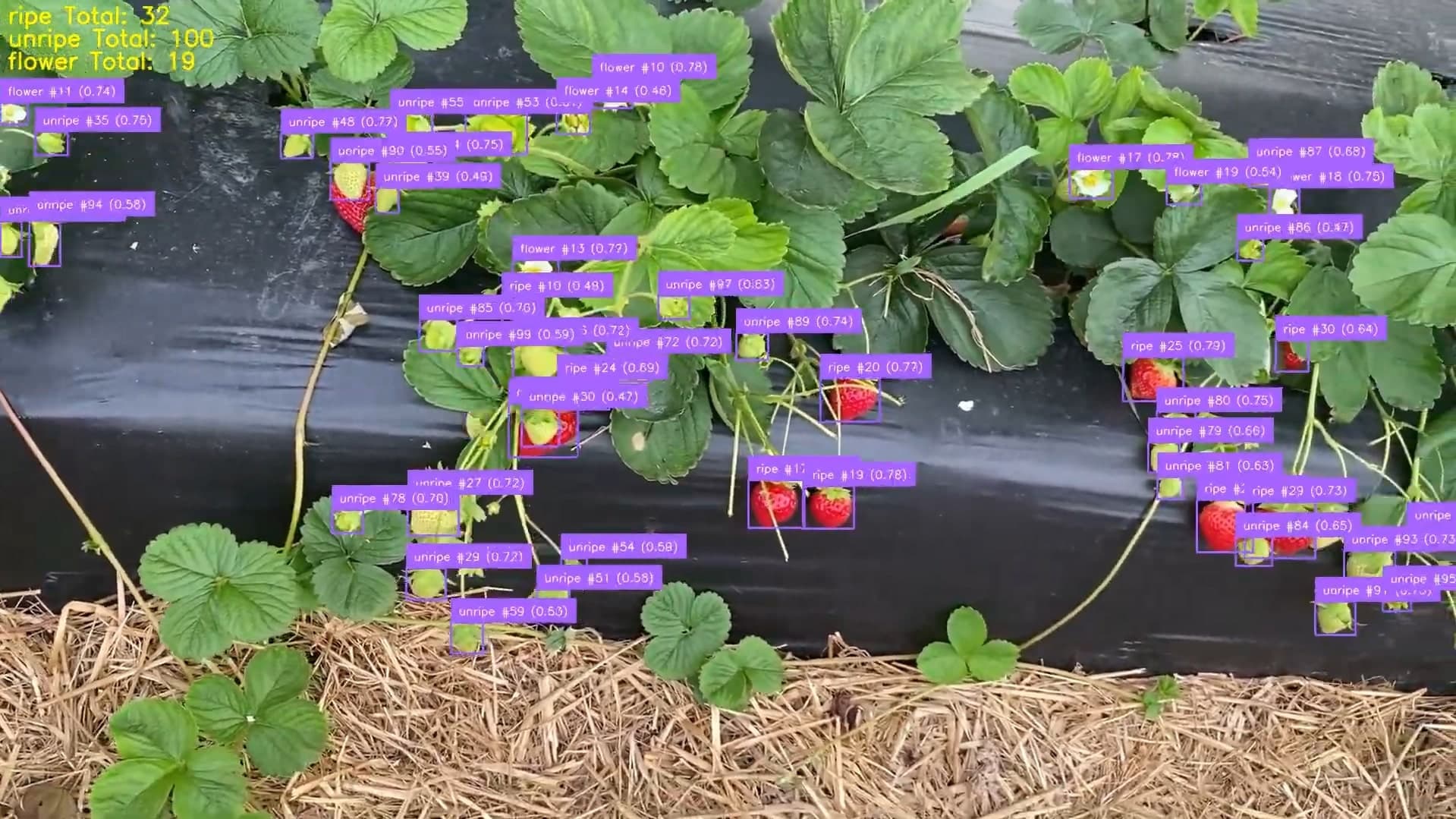
AI detection system analyzing strawberry plants
2. Accounts for Your Planting Pattern
It uses your row spacing, plant spacing, and gaps to calculate the actual planted area, not just total field size, so estimates match your layout.
Most yield calculators make a critical mistake: they assume every square foot of your field is planted. But you have pathways, irrigation lines, buffer zones, and areas where plants didn't establish. Our algorithm takes your specific planting pattern into account.
You input your row spacing, plant spacing within rows, and any gaps or irregularities. The algorithm calculates the actual planted area rather than just multiplying by total field size. This alone can improve estimate accuracy by 15-20% compared to simpler methods.
3. Handles Real-World Variability
It doesn't assume perfect conditions or normal distributions. It works with uneven data and gives you confidence ranges so you know how reliable the numbers are.
This is perhaps the most important feature. Rather than giving you a single number and hoping it's right, our algorithm provides a range: your expected yield, plus confidence intervals. You'll see something like '8,500 lbs ±750 lbs with 90% confidence.'
This tells you not just what to expect, but how certain you can be. If you have high variability in your samples, the confidence range will be wider, signaling you might want to take additional measurements or be more conservative in your planning. If samples are consistent, you'll see tighter ranges and can commit more confidently.
"The algorithm doesn't just give you a number—it tells you how much you can trust that number."
How the Technology Works
Behind the scenes, our system combines computer vision with robust statistical methods. When our autonomous wagons move through your fields or when you take manual samples with our mobile app, the computer vision system counts fruits, measures size, and assesses maturity.
This visual data feeds into a statistical engine that doesn't rely on assumptions of normality. Instead, it uses bootstrap resampling methods—a technique that repeatedly samples from your data to build up a distribution of possible outcomes. This approach is particularly powerful when dealing with small sample sizes or skewed distributions.
The algorithm also accounts for spatial autocorrelation—the fact that plants near each other tend to be more similar than plants far apart. This lets it make smarter estimates about unsampled areas based on the samples you do have.
Real-World Applications
Early in the season, use the algorithm to estimate potential yield based on blossom counts and early fruit set. This helps you plan labor needs, arrange cold storage, and begin conversations with buyers.
Mid-season, refine your estimates as fruits develop. The algorithm tracks changes over time and can project harvest timing based on maturity progression. This lets you schedule picking crews more precisely and give buyers accurate delivery windows.
Late in the season, get precise harvest forecasts. Know exactly how much fruit is ready today, how much will be ready tomorrow, and how much is still developing. This level of precision reduces waste, optimizes labor deployment, and ensures you're harvesting at peak quality.
Integration with Your Workflow
The algorithm is integrated directly into our Agro App. Take samples using your phone's camera, input your field parameters, and get instant estimates. As you add more samples throughout the season, the algorithm continuously refines its predictions.
If you're using our autonomous wagons, they automatically collect visual data as they work, feeding the algorithm without any additional effort on your part. This passive data collection means your yield estimates get better every day, with no extra labor required.
The Bottom Line
"It's accurate, practical, and built for how farms actually work."
Our algorithm combines computer vision with statistical analysis to give you yield predictions you can trust. Whether you have uniform or variable fields, our system adapts to your specific conditions and provides actionable insights for planning and decision-making.
We've tested this system across multiple growing seasons and diverse field conditions. The results speak for themselves: predictions typically fall within 10% of actual yields, even with limited sampling. More importantly, farmers tell us the confidence intervals help them make better decisions—they know when they can commit aggressively and when they should be more conservative.
This is precision agriculture that actually works in the real world. No perfect conditions required, no extensive infrastructure needed, and no advanced statistics degree necessary. Just practical tools that help you run your operation more effectively.